FMCSA Insurance Requirements: What Every Commercial Trucker Must Know
FMCSA requires minimum $750,000 liability for most interstate carriers. Learn who must file, what forms to submit, and the penalties for non-compliance.
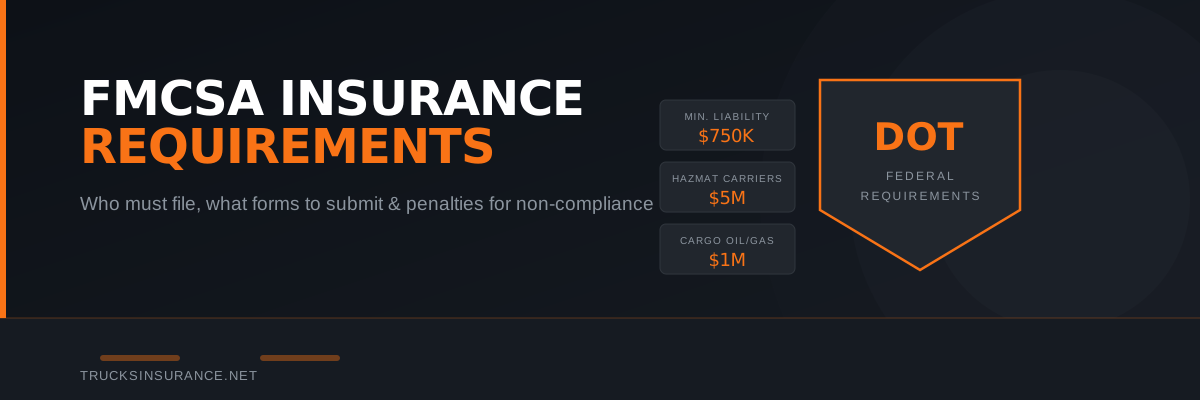
The Federal Motor Carrier Safety Administration (FMCSA) sets mandatory insurance requirements for all commercial motor vehicles operating in interstate commerce. Understanding these requirements isn’t just about compliance — an insurance lapse can revoke your operating authority, ground your trucks, and expose you to unlimited personal liability.
Who Must File Insurance with the FMCSA?
You must file insurance with FMCSA if you:
- Operate commercial motor vehicles (CMVs) in interstate commerce
- Have a DOT number and MC number (motor carrier authority)
- Carry passengers or regulated freight across state lines
- Haul hazardous materials in quantities requiring a DOT placard
Intrastate carriers (operating entirely within one state) typically register with their state DOT rather than FMCSA, though many states mirror federal requirements. Some states (California, Texas, New York) have additional state-level insurance filing requirements.
FMCSA Minimum Insurance Requirements by Cargo Type
| Cargo/Operation Type | Minimum Liability |
|---|---|
| General freight (non-hazmat) | $750,000 |
| Oil (non-hazmat) transported in bulk | $1,000,000 |
| Hazardous materials (specified in 49 CFR Part 387) | $5,000,000 |
| Hazardous waste | $5,000,000 |
| Passengers (8 or fewer) | $1,500,000 |
| Passengers (9 or more) | $5,000,000 |
Important: These are federal minimums, not industry recommendations. Most trucking industry professionals recommend $1,000,000 for general freight and $2,000,000–$5,000,000 for specialized operations.
The MCS-90 Endorsement Explained
The MCS-90 endorsement is a standardized insurance form that must be attached to every commercial trucking liability policy for federally-regulated carriers. It’s one of the most important — and least understood — documents in trucking insurance.
What it does: The MCS-90 endorsement makes your insurer the guarantor of last resort for public liability. It means that even if you violate your policy terms (drove an unauthorized vehicle, operated without proper authority, etc.), your insurer must still pay a public liability claim up to the minimum limits required by FMCSA.
What it means for you: The MCS-90 protects the public — not you. If your insurer pays out under MCS-90 due to a coverage violation, they can sue you to recover what they paid. It is not a blank check. Maintain policy compliance to avoid this exposure.
Who requires it: FMCSA requires the MCS-90 for all for-hire carriers subject to federal financial responsibility requirements.
How to File Insurance with FMCSA: BMC-91 and BMC-91X
Your insurance carrier files your insurance certificate directly with FMCSA on your behalf using standardized forms:
Form BMC-91 — Used for liability insurance. Your insurer files this electronically through FMCSA’s L&I (Licensing and Insurance) system. You don’t file this yourself — your carrier does.
Form BMC-91X — Used to cancel or revoke insurance coverage. This is filed by your insurer when your policy lapses, is cancelled, or expires without renewal. FMCSA typically gives carriers 30–35 days notice before revoking authority after a BMC-91X is filed.
Form BMC-34 — Used for cargo insurance (for property brokers and freight forwarders).
Form BMC-84/85 — Surety bond or trust fund, used by brokers as an alternative to insurance.
Consequences of an Insurance Lapse
An insurance lapse is one of the most serious compliance failures in trucking. The consequences escalate quickly:
Day 1 of lapse: Your insurer files BMC-91X with FMCSA Day 30–35: FMCSA issues notice of revocation After notice period: Operating authority is revoked — you are legally prohibited from operating in interstate commerce Continued operation after revocation: Criminal penalties, civil fines up to $16,000 per day, and personal liability for any accidents
Getting authority reinstated after revocation requires filing new insurance, paying reinstatement fees, and potentially waiting weeks for FMCSA processing.
Continuous Coverage: Why It Matters
Never let your policy lapse. Even a one-day gap in coverage can trigger BMC-91X filing and set the revocation process in motion. Strategies to prevent lapses:
- Set payment reminders 30 days before renewal
- Enroll in auto-pay for your insurance premium
- Work with a broker who will proactively alert you to upcoming renewals
- Keep a 60-day reserve — don’t operate so close to zero that a late payment causes a lapse
Beyond the FMCSA Minimums: What Coverage Do You Really Need?
Meeting FMCSA minimums is necessary but rarely sufficient. Consider:
$1,000,000 liability vs. $750,000: In a serious accident involving multiple injuries or fatalities, $750,000 covers legal fees, medical costs, and property damage of perhaps one moderate incident. A multi-vehicle accident with fatalities can easily generate $2,000,000–$10,000,000 in claims.
Cargo insurance: Not required by FMCSA (unless you’re a broker or forwarder), but required by virtually every shipper and freight broker. Most brokers won’t assign loads without proof of $100,000+ cargo coverage.
Physical damage: Not required by FMCSA, but required by any lender financing your truck. Even if you own your truck outright, operating without physical damage coverage means a total loss is your personal financial risk.
Use our free estimator tool to calculate your full coverage needs and get a rate range for your operation.
Get your instant truck insurance estimate
Use our free estimator tool to see rate ranges for your specific operation. Calculate your quote →